

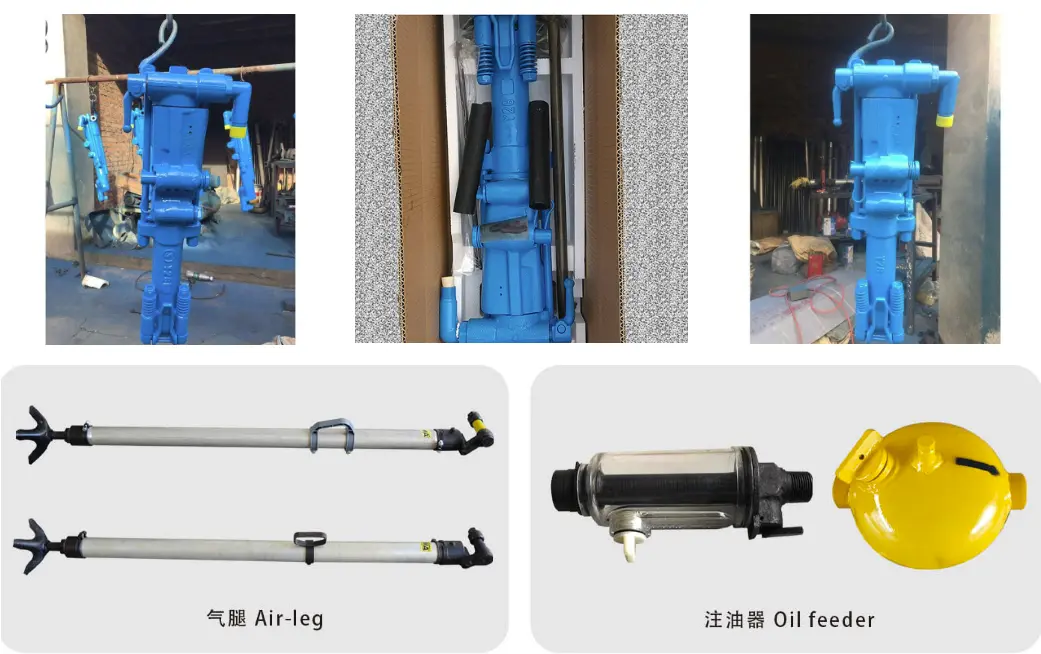
Six YT27 rock drills have been ordered. The shipment arrives with all six machines, yet the maintenance team can assemble only four complete drilling sets.
How does that happen?
Consider an example: six drill bodies, four compatible air legs and five lubricators are available. The mine already has six suitable drill-steel sets in its maintenance store.
Nothing is missing from the six drill bodies listed on the invoice. The problem is that the accessories available on site are insufficient for six complete assemblies.
This is a hypothetical purchasing example, not an actual customer delivery. It illustrates a distinction that matters when mines order equipment from overseas: the number of machines purchased and the number of complete drilling sets available are not always the same.
The Difference Between a Drill Body and a Complete Set
A purchasing manager may request six YT27 units, expecting the equipment to arrive ready for assembly. The supplier, meanwhile, may have quoted six drill bodies only.
Both parties can believe the order is correct until someone checks the accessories.
The YT27 pneumatic rock drill is commonly paired with an FT160A or FT160B air leg and an FY250 lubricator. Shenglida's published product information also identifies an R22 × 108 mm shank specification and a drilling diameter range of 34–45 mm.
These specifications help identify a suitable equipment configuration. They do not tell the buyer what is included in a particular quotation.
Before payment, the supply list should make that distinction clear. A drill body, an air leg and a lubricator are separate items unless the quotation explicitly groups them into a complete package.
The same applies to drill steels, hose fittings and other connections. Existing inventory may cover some of these requirements, but that needs checking rather than assuming.
Six Machines in the Warehouse, Four Sets for Assembly
Here is how the illustrative order would appear on a receiving sheet:
| Equipment | Available | Required | Shortage |
|---|---|---|---|
| YT27 drill bodies | 6 | 6 | 0 |
| Compatible air legs | 4 | 6 | 2 |
| Suitable lubricators | 5 | 6 | 1 |
| Compatible drill-steel sets | 6 | 6 | 0 |
Assuming one of each component is required for a set, the mine can assemble only four sets from the available inventory.
It needs two more air legs and one more lubricator to complete the planned six sets.
That shortage is relatively easy to identify on paper. It becomes more expensive to correct if the missing items are discovered only after the original shipment reaches a remote mine.
For buyers in Peru, Bolivia or other Latin American mining markets, an additional international shipment can mean another freight booking, customs paperwork and time spent waiting for parts.
The obvious question is whether the supplier could have included the missing components in the first shipment.
Why the Factory's Parts Range Matters
A rock drill purchase rarely ends with the first delivery.
Drill steels and bits are replaced as they wear. Seals, pistons and other internal components may need attention during maintenance. An additional drilling crew may require another air leg or lubricator.
Purchasing teams have to deal with these requirements long after the original machines have been installed.
Working with a rock drill manufacturer that can supply the machine, compatible accessories and common replacement parts can make that process simpler.
Instead of placing separate orders with several companies, a buyer may be able to obtain the required items from one supplier and arrange a consolidated shipment.
The benefit is not limited to freight. Every additional supplier means another quotation, another compatibility check and another set of shipping arrangements. These tasks take time, particularly when the purchasing team is managing equipment for a mine far from a major city.
A factory with a broad, well-documented parts range can also help reduce ordering mistakes. When part numbers, drill versions and previous purchases are properly recorded, a replacement order does not have to begin with identifying every component again.
However, a large spare-parts catalogue alone proves very little. Mines should ask whether the parts are actually available, which items must be manufactured and how long dispatch normally takes.
A single-source purchasing arrangement is useful only when the supplier can provide the correct components within an acceptable delivery period.
The Second Order Should Be Easier Than the First
Suppose the same mine needs replacement seals, two lubricators and another set of drill steels several months later.
Without a reliable equipment record, the purchasing team may have to compare drawings, measure old components and confirm which version of each part fits its machines.
That work becomes easier when the original supplier can refer to the equipment configuration, part numbers and previous purchase records.
The mine should therefore keep a copy of the confirmed parts list and request clear identification of the components supplied. This record is useful even if the mine later decides to purchase parts from another source.
For long-term procurement, the relevant question is not only which factory offers the lowest drill price today. It is also which supplier can support the equipment through subsequent maintenance and replacement orders.
Buying the correct parts together may reduce separate shipments, repeated technical checks and the risk of purchasing incompatible components. Actual savings will depend on stock availability, shipping arrangements and the mine's purchasing schedule.
Complete Sets Still Need a Suitable Air Supply
Having four fully assembled drilling sets does not necessarily mean four machines can operate at the same time.
The mine must still check whether its compressor, distribution lines and other services can support the intended work.
Pressure should be assessed at the drill inlet while equipment is operating, rather than relying only on a reading at the compressor.
Long underground air lines, additional pneumatic tools and high-altitude conditions may affect the air supply available at the working face.
This gives the purchasing department three different quantities to consider: drill bodies delivered, complete equipment sets available and drills that the site can support in operation.
They should not be treated as interchangeable figures.
A Better Starting Point for the Next Purchase Order
For a new YT27 order, the mine can ask the supplier to identify every included component and list any accessories that must be purchased separately.
If the mine intends to reuse its existing air legs, drill steels or lubricators, their specifications should be checked before the order is confirmed.
It is also worth requesting a priced spare-parts list with part numbers, stock information and expected dispatch times. Where possible, the purchasing team can discuss combining initial equipment and maintenance spares in one shipment.
For equipment specifications, see the YT27 air-leg rock drill product page.
Mining buyers can also share their required configuration, existing equipment details and destination country through Shenli Contact Us to request an itemized quotation.
Six drill bodies may be exactly what the purchase order specifies. But for the mine, the more useful question is how many complete sets can be assembled, how many can operate and where the next replacement part will come from.
Post time: Oct-12-2026
